
REVIEW · TURKEY HARBOUR CRUISES
Ephesus Small Group Tour from Kusadasi Port Cruiser Only
Ancient marble makes a powerful first impression. This five-to-six-hour Ephesus tour combines the Roman city, the House of the Virgin Mary, the Temple of Artemis, and lunch in one well-paced outing from Kusadasi Port. I especially like the small maximum of 15 people and the hourly morning departures, which help cruise passengers avoid hanging around the port.
I also like that the guide leads you downhill through Ephesus instead of sending you uphill through the ruins. The drawback is the price math: the advertised cost is only $31.31, but the Ephesus entrance fee of €40 and Mary’s House fee of €10 are extra, and drinks are not included.
Key points at a glance
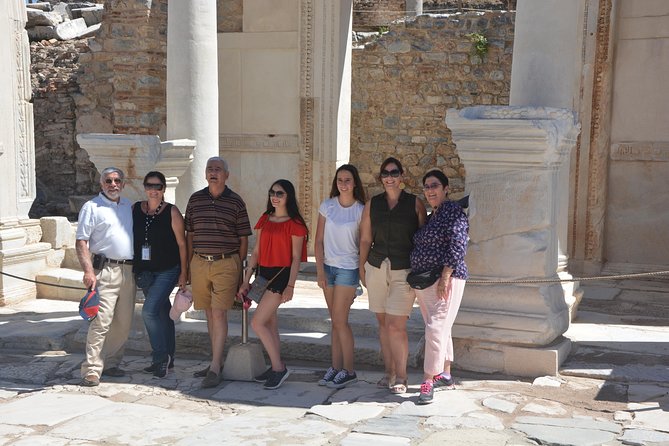
- A downhill route through Ephesus: Enter at the Magnesia Gate and walk past the major Roman sights toward the Great Theatre and Library of Celsus.
- A small group of no more than 15: The size should make it easier to hear your guide and ask questions.
- A strong mix of ancient and religious sites: You visit Ephesus, Artemis, and the House of the Virgin Mary in one morning and afternoon outing.
- Guides praised by name: Cetin, Ibrahim, Eda, and Orkan received specific praise for clear explanations, friendly service, and enthusiasm.
- Lunch is included: You will need to pay separately for drinks and the two main entrance fees.
- Built for cruise schedules: Pickup is at the main exit gate of Kusadasi cruise port, with hourly morning departures.
Why this Kusadasi shore excursion works well
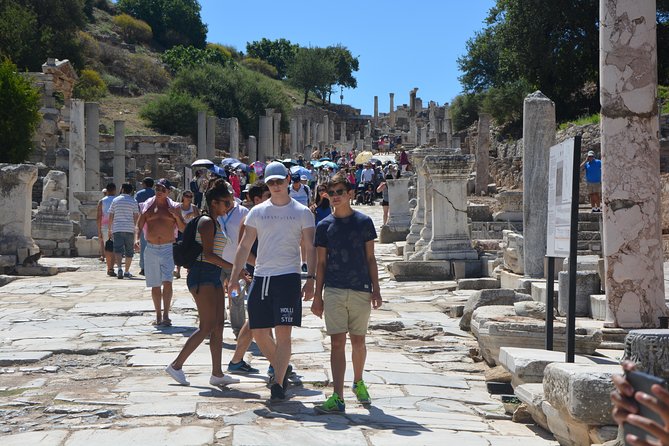
Ephesus is one of those places where a guide adds real value. On your own, you can admire fallen columns and broad stone streets, but it is harder to understand how the city worked as a Roman provincial capital. A good guide connects the buildings, explains their purpose, and gives shape to what can otherwise feel like a very large field of ruins.
This outing keeps the group small, with a maximum of 15 people. That matters at Ephesus, where a large crowd can make it difficult to hear beside the theatre or along Curetes Street. The tour is offered with an English or Spanish-speaking guide, and the public details identify English as the available language for booking.
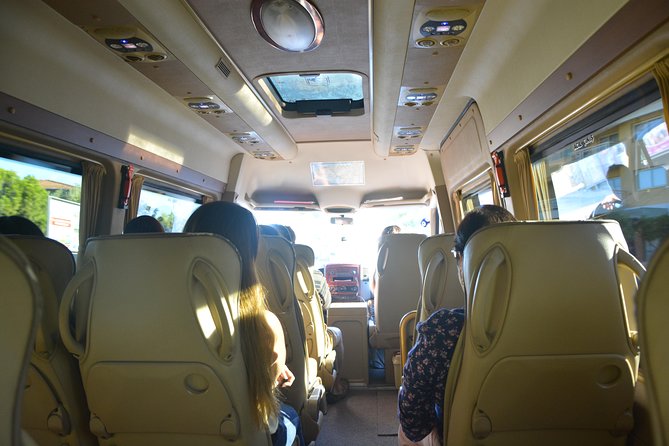
The schedule is also practical for a port call. Pickup takes place at the main exit gate of Kusadasi cruise port, and morning departures are offered hourly. That gives you some choice instead of forcing you into one fixed departure time. You still need to allow enough time to return to the ship, but the format is clearly designed for people arriving by cruise.
The tour runs about five to six hours. That is long enough to see the main archaeological sights and Mary’s House without turning the day into a marathon. Ephesus involves walking over uneven ancient surfaces, so comfortable shoes are important, even though the main route is downhill.
A few more boat trips around the world worth a look
- NYC: Circle Line 2h Harbor Lights Cruise Skip-The-Box-Office
★ 4.6 · 8,222 reviews - Hamburg: 90-Minute Evening Lights Harbor Cruise
★ 4.5 · 7,728 reviews - Hamburg: 1-Hour Evening Harbor Lights Cruise
★ 4.4 · 5,073 reviews
Entering Ephesus at Magnesia Gate
The main Ephesus visit begins at the Magnesia Gate. From there, the route moves downhill through the ancient city, passing several of its major landmarks.
That direction is one of the tour’s practical strengths. A downhill walk is easier than beginning at the lower end and climbing toward the upper gates, especially during a warm day. You will still walk for around an hour and a half inside the archaeological area, but the route should feel more manageable than a full uphill crossing.
Your guide points out the Temple of Hadrian, the Fountain of Trajan, the Great Theatre, and the Library of Celsus. These are not isolated monuments. Together, they show the public face of Ephesus, a city built around streets, civic buildings, religious sites, public bathing, and entertainment.
The Ephesus admission fee is not included. The stated cost is €40 per person. That extra charge is important when you compare this outing with other shore excursions. The tour covers your guide and parking, but you should budget for the entrance fee before booking.
The Library of Celsus and the Roman city
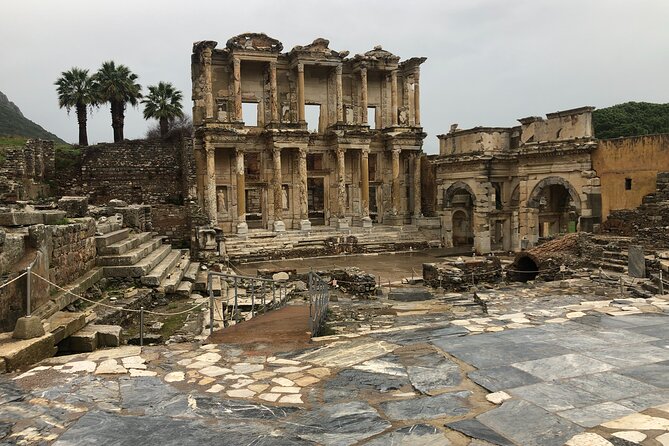
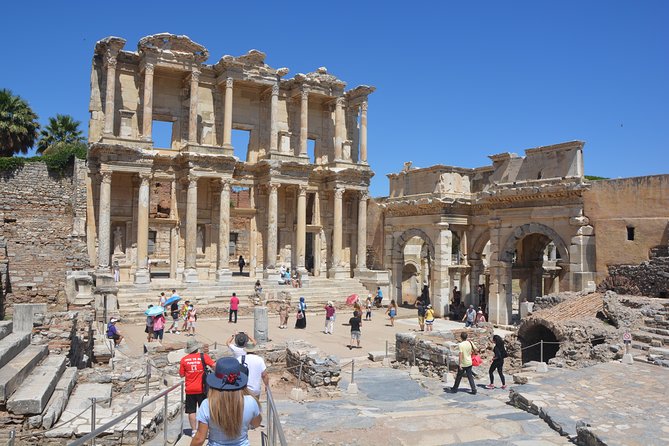
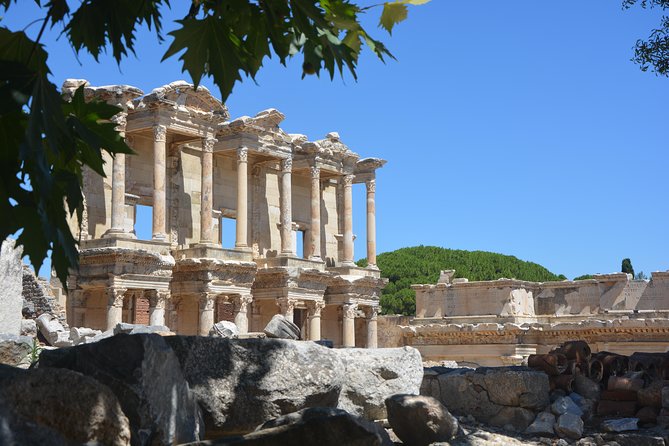
The Library of Celsus is the visual star of Ephesus, and you get time to see it during the guided walk. Its restored facade is one of the most recognizable views in Turkey, with columns and statues arranged across the front of the building.
The library was not simply a quiet place for private reading. Its grand design reflects the public role of knowledge and civic pride in Roman Ephesus. Your guide can help you understand why the building looks so theatrical and how it fit into the main street of the city.
The Great Theatre is another major stop. Its size gives you a sense of the scale of Ephesus as a city, rather than just a collection of ruins. The route also passes the Temple of Hadrian and the Fountain of Trajan, which add detail to the larger picture of Roman public life.
The planned time in the ancient city is about 90 minutes. That is enough to see the best-known sights with commentary, but not enough for a slow examination of every remaining wall and inscription. If you want a long, scholarly study of Ephesus, this is not that kind of visit. If you want the major monuments explained in a sensible order, the timing is more suitable.
One detail can be confusing in the schedule: the Library of Celsus is also listed separately for about 20 minutes, while it is included in the main Ephesus route. Treat it as one of the key highlights of the ancient-city visit rather than expecting two completely separate library stops.
The State Agora, Domitian, and the Baths of Varius
The State Agora was the governmental market area of Ephesus. You have about 15 minutes here, which gives your guide time to explain how the city handled civic business and public gathering.
The Temple of Domitian is another short stop, with roughly 15 minutes planned. It is described as the first known structure in Ephesus dedicated to an emperor. The temple occupied a large terrace supported by vaulted foundations, and stairs connected the different levels. You can still see parts of those stairs today.
The Baths of Varius offer a useful change of focus. Roman cities were not only about temples and theatres. Public baths were important social and practical spaces, and the surviving arrangement helps you picture the sequence of a Roman bathing complex.
The baths were built in the first century and restored in the fourth century by a wealthy Christian woman named Scholastica. A headless statue of Scholastica can be seen near the eastern entrance. Inside, the original plan included a dressing room, a cold room with a pool, a warm room, and a hot room with a developed heating system. A second floor was used for massage and scrubbing.
You get around 15 minutes here. That is brief, but it is enough to see the remains and hear why the building mattered. Do not expect to wander through every corner at leisure. The strength of this stop is the explanation, not a long period of independent exploration.
Same waterfront, a different kind of trip:
- San Francisco: Golden Gate Bay Cruise
★ 4.7 · 3,644 reviews - San Diego Harbor Cruise
★ 4.5 · 2,980 reviews - Circle Line: 2hr – New York City Harbor Lights Cruise
★ 4.5 · 2,859 reviews - Miami Combo: City Tour, Biscayne Bay Cruise and Everglades Airboat Ride
★ 3.5 · 2,487 reviews
The House of the Virgin Mary
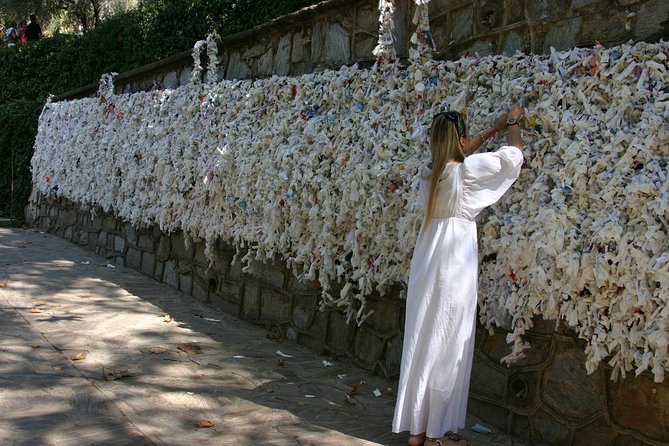
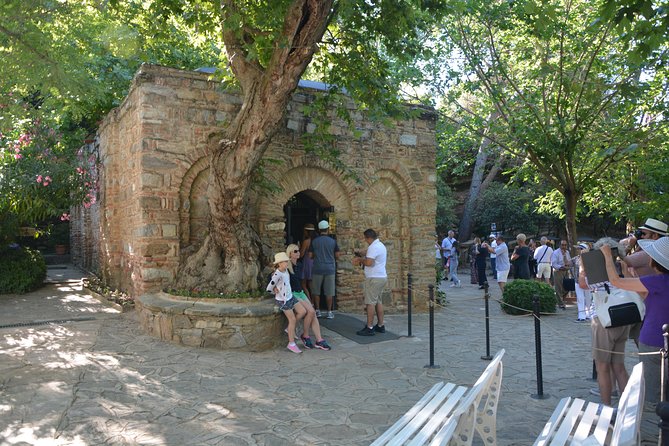
The House of the Virgin Mary sits on a different emotional and religious plane from the Roman ruins. Christian tradition holds that Mary came to Ephesus with the apostle John after the resurrection of Christ and spent her final days here.
A church now occupies the foundation of the house. The tradition has been supported by recognition from Pope Paul VI and Pope John Paul II, though the site remains a place of religious belief and pilgrimage rather than a standard archaeological monument.
The planned visit lasts about 45 minutes. That gives you more time here than at the smaller Roman stops. You can look around the church, take in the setting, and consider the importance of the place to Christian visitors.
The experience may feel uplifting or spiritual, but that depends on your own interests. If your main goal is classical archaeology, Mary’s House may feel less compelling than the Library of Celsus or Great Theatre. If you value religious sites, it adds a meaningful second layer to the day.
The entrance fee is separate, listed at €10 per person. That is in addition to the Ephesus admission charge, so the two required fees total €50 per person before drinks or any personal purchases.
The Temple of Artemis and the shorter stops
The Temple of Artemis is scheduled for about 20 minutes. The site is famous because the original temple was one of the Seven Wonders of the Ancient World. Today, you should expect a much quieter archaeological stop, with limited remains compared with the grandeur suggested by its ancient reputation.
That contrast is part of the appeal. At Ephesus, you see major facades and broad streets. At Artemis, the surviving evidence is more modest, and your guide’s explanation becomes especially useful. The stop helps you understand that ancient fame does not always translate into complete ruins.
The tour also allows time for shopping. Ibrahim and Eda were specifically praised for making the day informative and fun, while also including a great lunch and shopping opportunities. Shopping is not listed as a formal timed stop, so the amount of time available may depend on the day’s flow. If you prefer to spend every minute among the ruins, ask your guide how shopping fits into the schedule.
Lunch, drinks, and the real cost
Lunch is included, which is a useful perk on a half-day excursion. You do not have to stop and find a meal on your own, and the schedule can keep moving between the archaeological sites.
Drinks are not included. That sounds minor, but it is worth remembering when you are calculating the day’s cost. The advertised price is $31.31 per person, while the entrance fees add €50 per person. You should also allow money for drinks and any shopping.
At the base price, the outing offers good value for someone who wants transport from the port, a professional guide, parking fees, lunch, and several major sights in one package. The value is strongest if you want structure and interpretation rather than arranging separate transport and admission yourself.
The total price is less attractive if you are comparing it only with the headline figure. Ephesus is the main cost, and the additional €40 admission fee is substantial. Read the final booking details carefully so you understand which charges are included and which are paid separately.
Guides who make the difference
The strongest personal praise centers on the guides. Cetin was praised for explaining Ephesus, Mary’s House, and the Temple of Artemis, while also helping create a good lunch stop. Ibrahim and Eda were praised for answering questions and giving clear explanations about Ephesus and Turkey.
Orkan was described as friendly, passionate about Ephesus, and easy to talk with. The professional driver also received positive mention, which matters when you are being collected at a cruise port and moving between several sites.
Of course, guide quality can vary by departure. Still, these comments point to the kind of service this experience aims to provide: a friendly guide who explains the ruins instead of simply leading you from one photo stop to the next.
The group limit of 15 supports that approach. With fewer people, you have a better chance of asking about a column, street, or ritual that catches your attention. You should not expect a private tour, but this is smaller and more personal than a full coach group.
Who should book this Ephesus tour?
I would recommend it to cruise passengers who want the main sights without arranging every detail themselves. It suits you if you value a guide, want lunch included, and prefer a downhill walk through Ephesus.
It is also a good fit for families and mixed-interest groups. The schedule includes ancient architecture, Roman public life, a religious site, lunch, and shopping, so not everyone needs to be a specialist in classical history to enjoy the day.
Children must be accompanied by an adult. Most people can take part, but the ruins involve walking on ancient surfaces, and the tour lasts several hours. If you need a highly tailored pace or a fully private experience, the maximum group size of 15 may not be small enough.
You should also consider your port schedule carefully. Pickup is at the main exit gate, not simply anywhere along the ship. The tour is designed for cruise passengers, but you remain responsible for allowing enough time to get back to the vessel.
Free cancellation is available when you cancel at least 24 hours before the start time. Changes or cancellations made later are not accepted for a refund. The experience requires good weather, and a weather cancellation provides either another date or a full refund.
Should you book it?
Book this tour if you want a practical, guided introduction to Ephesus with Mary’s House, Artemis, lunch, and port pickup in one day. The most convincing reasons are the small group, downhill route, frequent morning departures, and repeated praise for guides such as Cetin, Ibrahim, Eda, and Orkan.
Think twice if you want a long, unhurried archaeological study or dislike paying entrance fees separately. At $31.31, the starting price looks excellent, but the extra €50 for Ephesus and Mary’s House changes the final cost.
For most cruise passengers, I think the organization and guide support make it a sensible choice. Go in knowing the real price, wear comfortable shoes, and treat the guide’s explanations as the key part of the experience.
FAQ
Where does the tour begin?
Pickup begins at the main exit gate of Kusadasi cruise port, where the Visit to Ephesus Travel Agency welcomes cruise passengers.
How long does the tour last?
The experience lasts approximately five to six hours.
What language is the tour offered in?
The tour is offered in English, and the guide may be English or Spanish-speaking.
How large is the group?
The group has a maximum of 15 travelers.
Is lunch included?
Yes, lunch is included. Drinks are not included.
Are the Ephesus entrance fees included?
No. The Ephesus entrance fee is listed separately at €40 per person.
Is the House of the Virgin Mary entrance fee included?
No. The House of the Virgin Mary entrance fee is listed separately at €10 per person.
Is the Temple of Artemis included?
Yes. The itinerary includes a visit of about 20 minutes, and the admission ticket is listed as free.
Can I cancel for a full refund?
Yes, if you cancel at least 24 hours before the experience start time. Cancellations made less than 24 hours in advance are not refunded. If poor weather causes the operator to cancel, you will be offered another date or a full refund.
Just added around the world
- Wismar: Harbor Cruise with Sea Animal Fishing and Guide★ 4.6 · 22 reviews
- Yokosuka: Boat Trip to an Uninhabited Island★ 5.0 · 16 reviews
- Yokosuka : Scenic Hidden Gem Hike and Naval Port Cruise★ 5.0 · 13 reviews
- Vancouver: North Shore Food Tour with Harbour ride★ 4.3 · 2 reviews
- Victoria: Kayak Harbour Tour★ 4.8 · 8 reviews
- Wednesday Regatta with harbour tour★ 4.8 · 8 reviews
- Wellington 90 minute Harbour Cruise★ 5.0 · 6 reviews
- Valletta: 3 Cities Guided Tour & Grand Harbour Boat Tour★ 4.8 · 15 reviews
Turkey Harbour Cruises, compared.

Private Sirince Village Tour From Kusadasi Port Cruiser Only
Read our review →

Kusadasi: EPHESUS PRIVATE PORT TOUR FOR CRUISES-SAVE TIME
Read our review →
Browse the lists this tour appears in